
The AI boring law
Why LLMs don't have 'negative capability' and should I use chatGPT for brainstorming?

‘Everything is a copy of a copy of a copy’
Fight Club
AI models seem to be becoming more homogenous as they become more powerful. In a recent paper Cornell researchers found that as models become larger their errors become more correlated. In other words, they fail in more homoegenous ways.
Some argue this is partly due to RLHF (Reinforcement Learning with Human Feedback). This is when models are trained based on human preferences (e.g. humans have rated responses from 0-10 and models try to output responses that would be likely to get a high preference).1 However, others say that the ‘Generative monoculture’ of LLMs goes to the core of how LLMs work.
As a raw technology LLMs are fundamentally convergent. Psychologist Barbara Tversky has argued that creativity involves a to-and-fro between knoweldge and unlearning (breaking from A→ B chains to A → C chains, reordering steps, considering unexpected connections. This is approaching what the poet John Keats famously called the ‘negative capability’ of the creative process. In a letter to his brother in 1817 he wrote about “what quality went to form a Man of Achievement especially in Literature & which Shakespeare possessed so enormously — I mean Negative Capability, that is when man is capable of being in uncertainties, Mysteries, doubts, without any irritable reaching after fact & reason.” For Keats the retention of some unresolved ambiguity and openness to complexity is essential for creativity. LLMs (as they are currently) don’t really allow for this negative space. They are technologies of language modelling and simulation. Multiple possible completions are assigned a probability and chosen via some sampling method (e.g. beam search of top-n sampling). In a sense LLM architectures are the opposite of negative capability - they apply the downward pressure of all digitised knowledge to reduce uncertainty over the probability of possible text completions.
But sometimes it’s better to have less knowledge. In one study a group of 180 data scientists were given a statistical modelling problem and assigned into one of two groups. Group A shared their solution ideas with the entire group (an efficient network) while Group B only shared their solutions with their immediate 4 neighbours. In every trial the groups who didn’t share their solutions with all their neighbours (i.e. the inefficient networks) came up with a better solution.
One reason the authors posit for this result is that more widely connected groups land on worse solutions and settle.2 In other words, they check-out from the creative and thinking process sooner and the range of possibilities explored becomes more narrow. Studies which have tried to measure the creativity of AI vs humans consistently suggest that current level AI produces more creative outputs than average human responses, but the most creative human responses are still the best responses overall.3 In other words, LLMs can increase creativity at the individual level, but at the collective level reduce it.
The homogenisation effect is not necessarily a bad thing if we use AI accordingly. For many use cases we want to align AI and steer it based on preferences, rather than always having it output wild and weird content. However, we ideally don’t want to become more boring ourselves. We should therefore think carefully about how and when to use llms in the creative process.
Can we still brainstorm with ChatGPT?
If AI is becoming more boring this doesn’t mean it can’t be used in the creative process. But it does inform the question of where in the creative process it should be used.4 Multiple organisations working in science & engineering have been working on this to develop solutions that leverage LLMs to be creative.
The question of whether AI homogenises or diversifies creativity depends a lot on how it is embedded into systems. The MIT Supermind Ideator uses structured prompts and scaffolding to help people frame and reframe problems—reducing the chance of shallow, obvious answers. Tools like AutoTRIZ or Scideator build on formal methods from engineering or science, guiding LLMs through recombination processes that push users beyond local minima. By contrast, platforms such as BioSpark take an analogy-driven approach, surfacing biological inspirations and nudging users to reflect on trade-offs. These systems deliberately add friction or alternative perspectives, rather than just amplifying the first idea that comes to mind.
Even more experimental are AI systems like Google DeepMind’s AlphaEvolve, which borrow from evolutionary computation. Instead of optimising for immediate human preference (as RLHF does), AlphaEvolve evolves solutions through variation, selection, and recombination—mimicking biological creativity. This is closer to the “inefficient networks” in Centola’s study: slower, more diverse exploration that avoids premature convergence.
Though AI writers, such as Ethan Mollick, argue we should ask ChatGPT for ideas, this probably isn’t the best stage at which to use AI in our creative process.
Duchamps of the AI Age?
Bernard Stiegler argued that the standardisation of the industrial age led to a raft of new types of creative expression. For example, Marcel Duchamp took the newly standardised time of the industrial age and played with this standardisation to create a new type of portrait. Nude Descending a Staircase shows a naked model who is depicted in multiple notions of time simultaneously. If AI does have a standardisation effect perhaps we may need some new Duchamps.
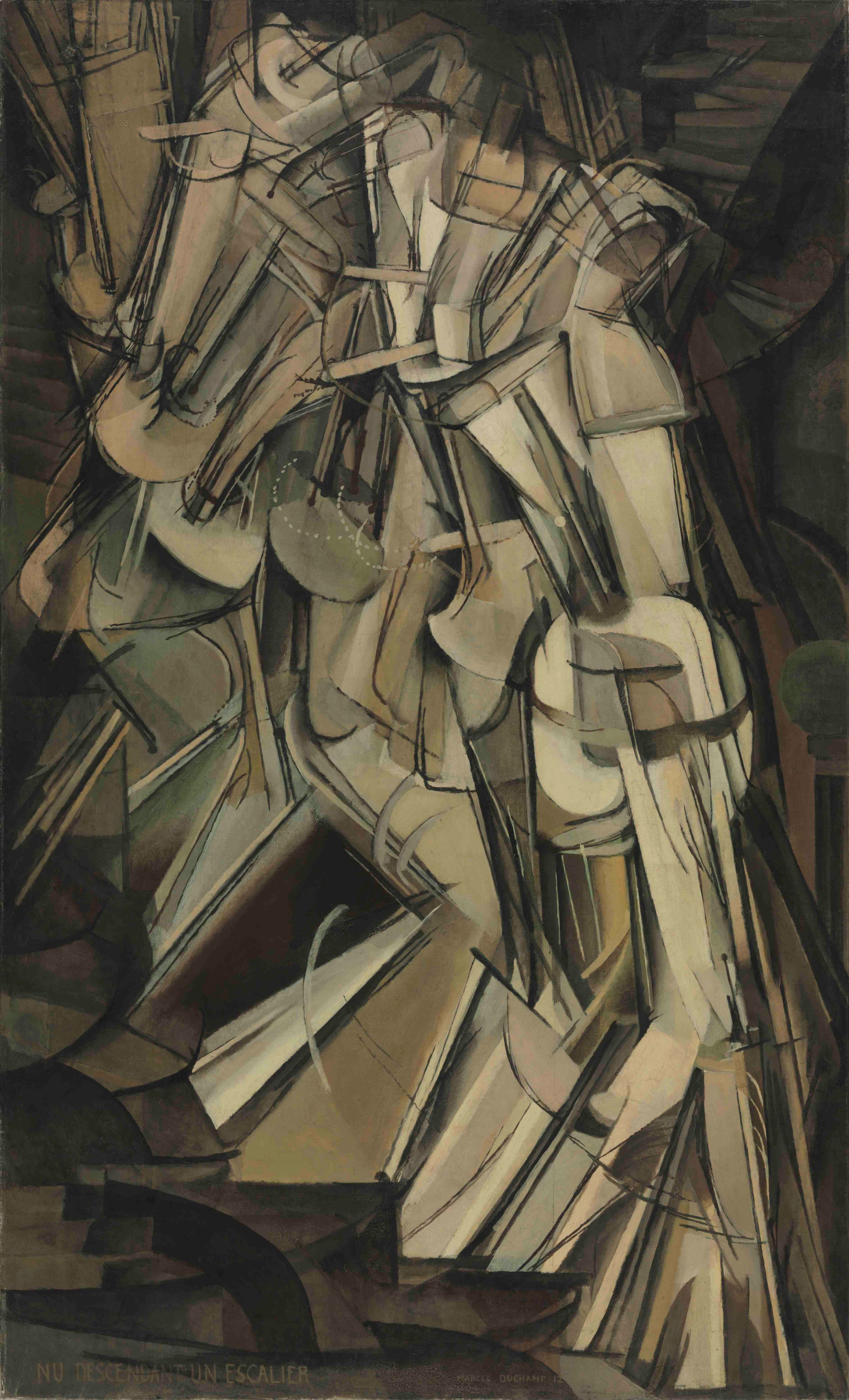
Nude Descending a Staircase No. 2
In a sense it’s not surprising that training on human preferences makes outputs less diverse. Look at pop music. As psychologists have noted, creativity often involves going against the grain of social norms.
This is an insight that animates DARPA’s decision to have a 3-5 year rotating staff model.
AI tends to especially help people who have less confidence in a domain.
The writer Ethan Mollick in his recent book advocates using chatGPT to output ideas as part of brainstorming. Given the above, this use of models over time opens us up to more homogenised thinking and ideas. Equally, the recent New Yorker article which argues that AI homogenises our thoughts assumes quite a basic form of AI interaction (citing studies where people used AI for autocomplete or Q&A). Jeremy Uttley at Stanford’s Design School has argued that one of the key bottlenecks in creativity is the ability the number of experiments you can carry out —to quickly explore how an idea might play out without having to build it in the real world. AI is well placed to help here: it can generate scenarios, analogies, or rapid prototypes that make the “what if?” stage less costly and more expansive. Though, again, are curent models still too fundamentally convergent?